
What is the most likely explanation for his current clinical situation?
Aspiration pneumonia
It is possible that the patient developed an aspiration pneumonia during the procedure, however this would have likely resulted in intra- procedural or immediate post – procedural decompensation, cough or fever. However, it is less likely that patient would have developed an acute aspiration episode while eating post stent placement, since the esophageal obstruction is relieved
Administration of a wrong medication
There is no mention of starting new medications, and the patient’s existing medications would be unlikely to cause acute decompensation.
Refeeding syndrome
You are right!
This patient has developed Refeeding syndrome
ASPEN defines the criteria for refeeding syndrome as follows
A decrease in serum phosphorus, potassium, and/or magnesium levels by 10%–20% (mild), 20%–30% (moderate), or >30% and/or organ dysfunction resulting from a decrease in any of these
and/or
Due to thiamin deficiency (severe), occurring within 5 days of reintroduction of calories.
During profound starvation energy stores, as well as vitamins and intracellular electrolytes, are depleted. During refeeding, when glucose appears in the bloodstream, insulin secretion rises in response. In the presence of a total-body deficit of potassium, phosphorus, or magnesium, a drop in serum concentrations may occur because of rising insulin levels..
Rising insulin levels drive phosphorus and potassium intracellularly both by demand (ie, phosphorylation of glucose as glycolysis is initiated) and through the direct effects of insulin (ie, stimulation of the sodium-potassium adenosine triphosphatase [ATPase]).These decreases may occur even if serum levels of electrolytes are initially normal.
The decrease in serum electrolytes may be sudden and severe and can be deadly for an individual who has been in a starved or catabolic state.
Serious consequences of refeeding syndrome can include acute pulmonary edema, congestive heart failure, and sudden cardiac death.
ASPEN criteria for identifying those at risk for Refeeding syndrome
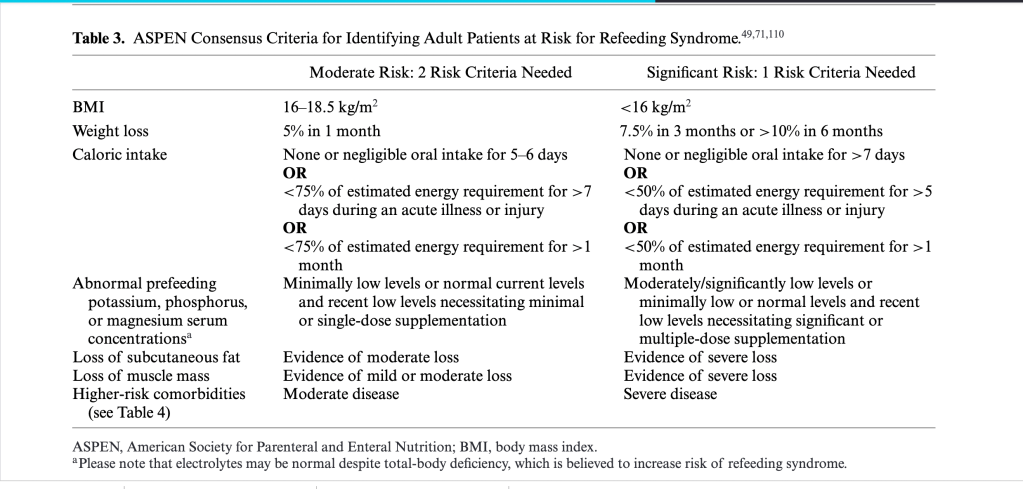 This patient had unintentional weight loss of > 10% in the past 6 months and <50% of estimated energy requirements for > 5 days, which make him high risk for re feeding syndrome.
To prevent refeeding syndrome the NICE guidelines recommend thorough nutritional assessment for identification of high-risk individuals.
https://www.nice.org.uk/guidance/cg32
Plasma electrolytes should be monitored prior to initiation of and during feeding, and feeds should be initiated at no more than 50% of their energy requirements, in “patients who have eaten little or nothing for more than 5days
This patient had unintentional weight loss of > 10% in the past 6 months and <50% of estimated energy requirements for > 5 days, which make him high risk for re feeding syndrome.
To prevent refeeding syndrome the NICE guidelines recommend thorough nutritional assessment for identification of high-risk individuals.
https://www.nice.org.uk/guidance/cg32
Plasma electrolytes should be monitored prior to initiation of and during feeding, and feeds should be initiated at no more than 50% of their energy requirements, in “patients who have eaten little or nothing for more than 5days
This patient had unintentional weight loss of > 10% in the past 6 months and <50% of estimated energy requirements for > 5 days, which make him high risk for re feeding syndrome.
To prevent refeeding syndrome the NICE guidelines recommend thorough nutritional assessment for identification of high-risk individuals.
https://www.nice.org.uk/guidance/cg32
Plasma electrolytes should be monitored prior to initiation of and during feeding, and feeds should be initiated at no more than 50% of their energy requirements, in “patients who have eaten little or nothing for more than 5days
Click here for more reading material and references on this topic
 nutribytes.org